What is Automated Treatment of Name Screening Alerts?
Name screening alert treatment is still one of the biggest time drains in AML workflow. Lots of repetition, lots of manual work.
This is why Cascade has just launched Automated Treatment of Name Screening Alerts, which auto-classifies hits and generates the supportive narrative to justify the classification. You maintain full audit trail with time logs and owner logs. You retain control and approvals, while repetitive hit treatments are automatically and instantly classified by Cascade agent. Our customers value the most the generated justification narratives, which are clear, concise and transparent.
Regulatory expectations in the EU and Luxembourg continue to emphasize a risk-based approach, robust sanctions controls and strong record-keeping. Consistent triage with stored rationales supports these expectations and can ease audit, internal reviews and take away a lot of manual work from your AML workflow.
What changes for operations
- Less repetitive triage: The hits are automatically classified into correct matches and false positives.
- Clear Narratives: Each classification includes a concise, transparent justification in a structured form with summary of matching criteria for name match/mismatch, country match/mismatch, city match/mismatch, trade register information, etc.
- Control and auditability preserved: Approvals remain under your governance. Every decision is recorded and logged with timestamps and users.
These outcomes align with supervisory themes: risk-based approach, documented decisions that are explainable, and effective governance over sanctions and screening.
How it works:
- Screen as usual: Alerts land in your existing Cascade workflow.
- Classification proposal: The system generates classification for all your hits, reflecting your sensitivity of screening. Common fuzzy matches follow prescribed handling, designed to be easy to review.
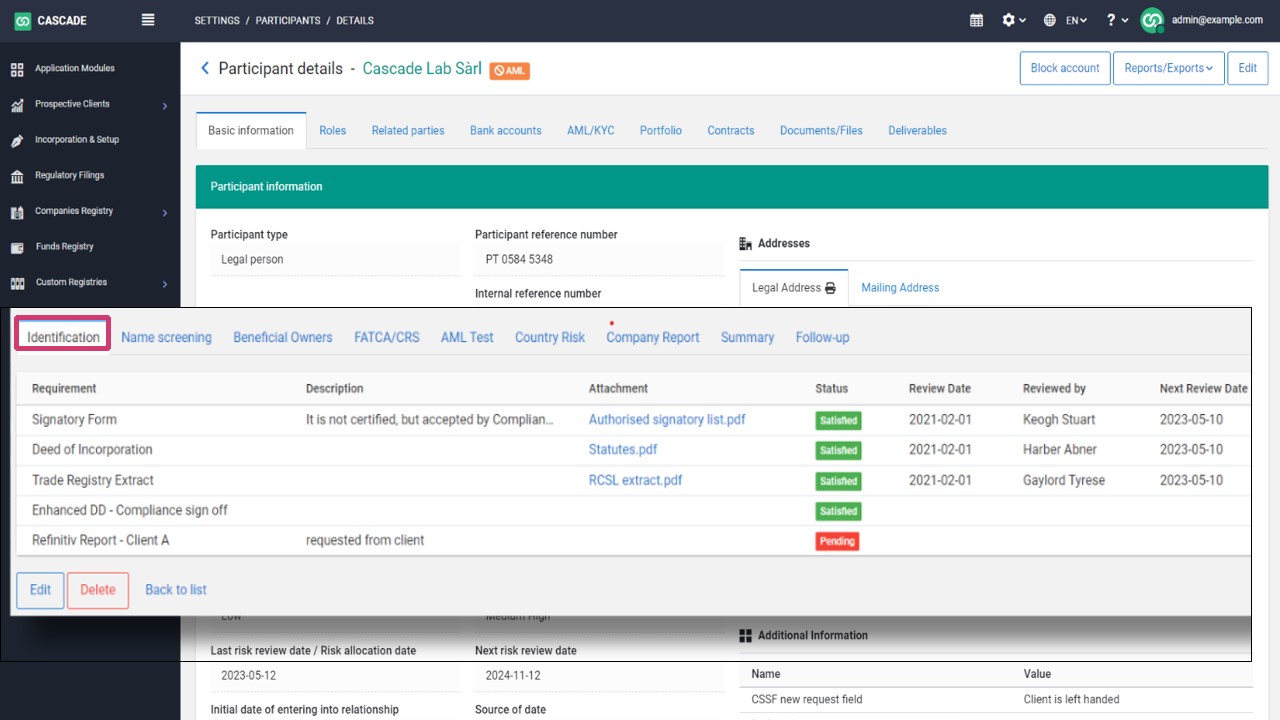
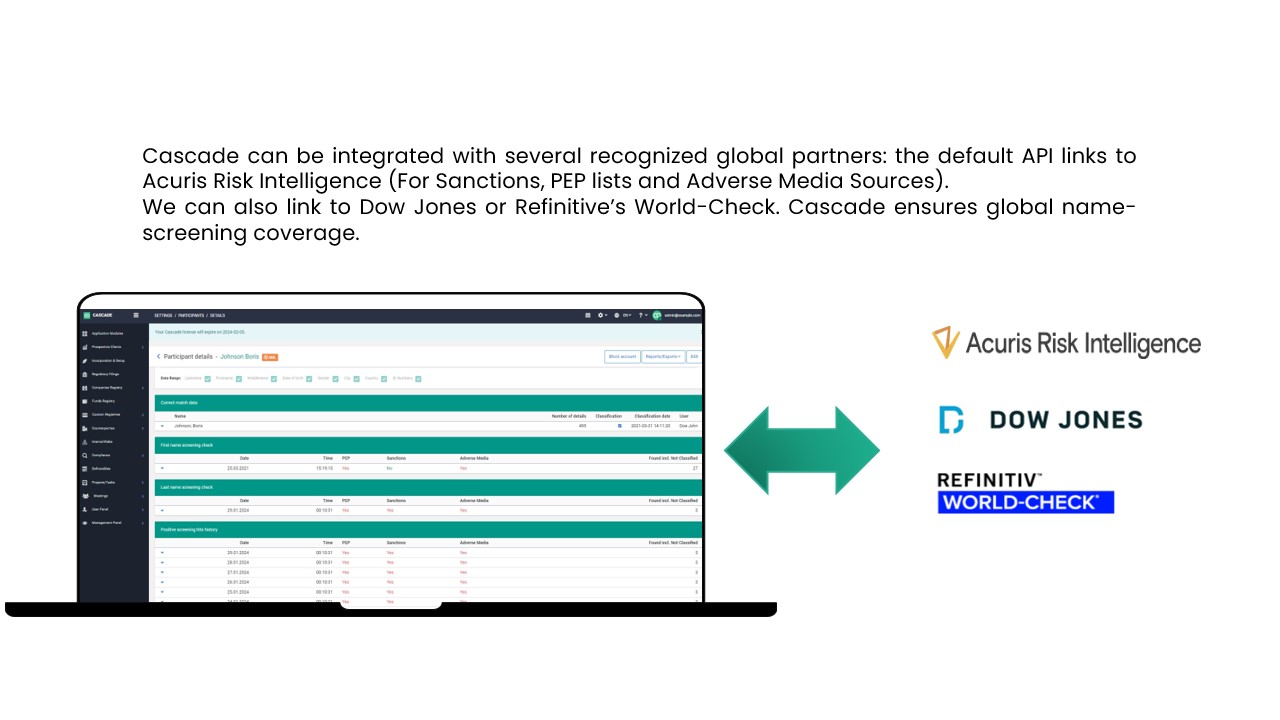
- Concise narrative: A short rationale generated by Cascade agent explains why the alert is likely a false positive or a true hit. The narrative references the key parameters considered (see images below).
- Human in the loop: Analysts accept, edit or reject.
- End-to-end evidence: Suggestions, edits and final actions are captured with time logs and owner logs, supporting internal reviews and external inspections.


Why this matters now
- Volumes are rising: it increases repeat work and repeat hit treatment. Regulators remind companies to analyse screening results and duly assess potential hits, including timely attention to official sanctions lists.
- Regulators expect traceability: FATF standards and EU guidance stress record-keeping and explainability of AML controls. Consistent narratives stored with cases strengthen audit readiness.
- Sanctions governance is tightening: EBA’s sanctions guidelines set common EU standards for internal policies, procedures and controls, with application beginning December 2025 for institutions in scope. Structured screening workflows and replayable audit trails align with those expectations.
Who benefits most
- Teams screening at high volumes: Cascade automates hit treatment and classification for name screening alerts, so compliance operation analysts spend less time on alert treatments.
- Fund and corporate administrators: Periodic KYA reviews and watchlist refreshes increase the volume of name screening hits. Cascade automates hit classifications with prescribed handling and a concise justifying narrative, which reduces time spent on this manual task.
- Banks, PSFs, fintechs and payments: Automated classification with stored narratives and a full audit trail, including time logs and owner logs, helps internal reviews and increase efficiency.
FAQ: Automated Treatment of Name Screening Alerts
- What is the automated treatment of name screening alerts?
A Cascade new released feature that automates hit classification and generates a concise, explainable narrative to justify the classification. It is fully aligned with risk-based approach in AML and creates a complete audit trail for internal and external audits. - Who is it for?
Any organisation that needs to screen names, especially at scale, including fund and corporate administrator, banks, PSFs, fintechs, payments. - How does automated treatment of name screening alerts help compliance teams?
It reduces repetitive name screening alert treatment by automatic classification with generated justification.It keeps the full audit trail and makes the work of compliance officers fast and efficient. - Does it replace compliance analyst decisions?
No. It is human in the loop. Analysts approve, edit or reject proposals and remain accountable for the final decision. It helps though both makers and checkers: for makers it accelerates the treatment of hits, for checkers it provides clear concise traceable justification narratives of the classifications. - How are fuzzy matches handled?
The system proposes a classification with consistent narratives why it is correct match or false positives in a structured form with summary of matching criteria for name match/mismatch, country match/mismatch, city match/mismatch, trade register information and similar, so that reviewers can confirm or adjust quickly.
Related reading
- CSSF overview of AML and CFT expectations for a risk-based programme.
- EBA ML/TF risk-factor guidelines for calibration and periodic reassessment.
- FATF Recommendations, including record-keeping and effectiveness themes.
Explore Cascade’s KYA Capabilities
Ready to evaluate the impact on your queues. Explore Cascade’s KYA Capabilities or Get Started with AML Tools and request the Automated Treatment of Name Screening Alerts preview by clicking “Get a Demo” button.
Friendly disclaimer
This article is for general information only and based on publicly available sources at the time of writing. We’ve done our best to make it accurate and useful, but AML rules and business needs can change. Always double-check key details and speak with a qualified expert before making compliance or vendor decisions.


 English
  English (Australia)
  English (UK)