Periodic AML controls testing and effectiveness verification for Luxembourg-regulated funds
AML controls testing is the systematic periodic verification that anti-money laundering and terrorist financing controls are operating effectively across your compliance infrastructure. Luxembourg fund managers must operationalize controls testing on a documented schedule to meet Commission de Surveillance du Secteur Financier (CSSF) expectations and maintain evidence of control effectiveness for regulatory inspection.
Key Takeaway: This guide explains how Luxembourg funds establish and execute a systematic AML controls testing schedule, the regulatory expectations governing control verification, and practical implementation methods to embed testing workflows into your compliance operations.
Introduction
Luxembourg fund managers operate within one of Europe’s most rigorous regulatory environments. The CSSF expects fund managers to implement controls proportionate to their money laundering and terrorist financing risk profile, but implementation alone is insufficient: the CSSF also expects documented evidence that controls are actually working as designed.
Without a systematic controls testing schedule, compliance teams operate reactively. Testing occurs ad hoc or in response to regulatory pressure rather than on a planned calendar. When the CSSF examines your fund during supervisory visits, it discovers control gaps that could have been identified months earlier through disciplined testing. This creates regulatory findings and a remediation workload.
Spreadsheet-based controls testing creates fragmented testing records, inconsistent testing coverage, and incomplete audit trails. Testing checklists exist across multiple files; results are scattered in email attachments; trends in control failures are not tracked systematically. When regulators request evidence that controls were tested and validated, compliance teams struggle to produce complete, organized documentation.
This article explains the CSSF’s control testing expectations, outlines a practical implementation framework, and demonstrates how compliance software can systematize control testing to create auditable evidence of control effectiveness before regulatory inspection occurs.
What is AML controls testing?
AML controls testing is the periodic operational verification that AML controls are functioning as designed and are effectively mitigating money laundering and terrorist financing risk. Testing involves sampling client files, transaction records, or control execution events; verifying whether documented control procedures were followed; and investigating any deviations or failures.
In Luxembourg fund management, controls testing typically addresses client due diligence procedures (identity verification, beneficial ownership assessment), sanctions and adverse media screening execution, risk assessment and categorization, transaction monitoring threshold application, beneficial ownership update procedures, and suspicious activity investigation protocols.
Effective controls testing is not a one-time exercise: it is a recurring calendar-driven process where compliance teams systematically sample control execution, identify failures or inefficiencies, and remediate gaps before they accumulate into regulatory findings.
Why it matters for Luxembourg funds
Luxembourg funds face three converging regulatory and operational pressures regarding controls testing:
Regulatory intensity
The CSSF expects documented evidence that controls are tested periodically and operate effectively. Without a systematic testing schedule, you cannot demonstrate to regulators that control failures have been identified and addressed.
Supervisory scrutiny
During CSSF supervisory visits, regulators examine whether controls testing has occurred, review testing documentation, and assess whether findings have been remediated. Funds without systematic testing programmes face heightened regulatory findings and potential enforcement action.
Operational blindness
Manual, undocumented testing creates gaps. Some controls are tested frequently; others are never tested. When control failures occur, they go undetected until discovered by regulators or during internal audits. This creates reactive compliance and higher remediation costs.
Systematic AML controls testing addresses each pressure by embedding testing into a documented, calendar-driven schedule; creating auditable evidence of testing execution; and enabling rapid detection and remediation of control failures.
CSSF and AML controls testing expectations
The CSSF Regulation 23-02 (Investment Fund Regulation) and the CSSF’s Guidelines on Money Laundering and Terrorist Financing Risk Assessment establish explicit expectations for control testing and verification.
Key regulatory expectations:
Periodic control verification
Fund managers must test and verify that AML/KYC controls are operating effectively. Testing must occur on a documented schedule and be proportionate to risk.
Testing independence
Control testing should be conducted by personnel independent of those executing the controls. This ensures objective assessment of control effectiveness.
Documented testing procedures
The fund must maintain written procedures governing what is tested, how testing is performed, sample sizes, and when testing is escalated to senior management or the MLRO.
Remediation of failures
When control testing identifies failures or inefficiencies, the fund must document the failure, investigate the root cause, implement corrective action, and verify that corrective action is effective.
Audit trail and evidence retention
All control testing must be documented. Testing results, remediation decisions, and follow-up verification must be retained for regulatory inspection.
Establishing your AML controls testing schedule
Step 1: Define the testable control universe and testing scope
Inventory all AML controls operating in your fund:
- Client onboarding controls: identity verification completion, beneficial ownership assessment quality, risk categorization
- Screening controls: sanctions screening execution at onboarding, periodic re-screening frequency, adverse media monitoring
- Transaction monitoring controls: threshold application by risk category, investigation initiation for alerts, alert investigation documentation
- Beneficial ownership controls: update request procedures, verification quality, periodic re-verification completion
- Reporting controls: suspicious activity investigation documentation, SAR filing procedures, timely filing to authorities
- Audit trail controls: timestamping of key decisions, retention of supporting evidence, data quality
For each control, define the testable population (e.g., for client onboarding controls, the testable population is all clients onboarded in the prior quarter).
Step 2: Design testing methodology and sample sizing
Establish how each control will be tested:
- Compliance testing: Sample client files and verify whether required procedures were completed to standard (e.g., did the compliance team collect identification documents, verify beneficial ownership, perform screening?)
- Effectiveness testing: Verify that controls are achieving their intended risk mitigation objective (e.g., did transaction monitoring thresholds detect suspicious patterns?)
- Timeliness testing: Verify that controls are performed on schedule (e.g., were beneficial ownership updates requested within 12 months? Were screening results reviewed within required timeframes?)
Sample size guidance: For low-risk populations, sample 10-15% of transactions or clients per testing cycle; for high-risk populations, sample 25-30% or test all items. Document your sampling methodology.
Step 3: Establish testing schedule and frequency
Create a calendar-driven testing schedule:
- Monthly testing: Transaction monitoring control effectiveness (sample recent alerts, verify investigation quality, verify escalation procedures)
- Quarterly testing: Client due diligence controls (sample new clients and recent onboardings, verify due diligence completion and quality)
- Semi-annual testing: Beneficial ownership controls (sample updates, verify whether updates were requested and responses received)
- Annual testing: Sanctions screening controls, reporting controls, and audit trail controls
Assign testing responsibility to specific personnel (typically a dedicated compliance officer or internal audit function). Document the testing schedule in your control risk assessment framework and communicate it to your compliance team.
Step 4: Document testing execution and maintain audit trail
Implement a systematic process for capturing testing results:
- Testing checklist or questionnaire for each control, completed during testing
- Sample identification (e.g., client name, transaction date, alert ID)
- Testing findings: Deviations from control procedures, failures to execute controls, quality issues
- Root cause assessment: Why did the control failure occur? (staff error, system misconfiguration, inadequate training, resource constraints)
- Remediation decision: What corrective action will prevent recurrence?
- Follow-up verification: When will remediation effectiveness be tested?
- Tester identity and testing date
Retain all testing documentation in a centralized location (not scattered across email or individual spreadsheets). Link testing results to control execution events so that testing evidence connects to operational data.
AML controls testing schedule matrix
| Control Area | Testing Frequency | Sample Population | Key Testing Questions | Audit Trail Documentation | Escalation Trigger |
|---|---|---|---|---|---|
| Client identification and verification | Quarterly | 15% of new clients onboarded in the prior quarter | Were ID documents collected? Was the identity verified against a reliable source? Are ID copies retained? | Testing checklist, sample client file reference, tester identity, testing date | Identity verification incomplete for any sampled client |
| Beneficial ownership assessment | Quarterly | 15% of new clients onboarded in the prior quarter | Was UBO assessed? Are UBOs identified and documented? For complex structures, was verification obtained? | Testing checklist, beneficial ownership chart review, verification evidence assessment | UBO unverified for high-risk client; opaque structure not flagged |
| Sanctions screening execution | Monthly | 100% of alerts generated in the prior month | Was screening performed at onboarding? Are periodic rescreens occurring per schedule? Were screening results reviewed? Were matches investigated? | Alert log, screening result dates, investigation memo, resolution decision | Screening not performed per schedule; match not investigated |
| Risk assessment and categorization | Quarterly | 20% of high-risk clients; 10% of medium/low-risk clients | Was risk assessment completed? Is assessment documented with rationale? Is categorisation consistent with criteria? | Risk assessment memo, assessment date, assigned risk category, supporting evidence | Inconsistent risk categorisation; high-risk client not flagged |
| Transaction monitoring threshold application | Monthly | 100% of alerts (all transactions above threshold) | Were alerts generated per established thresholds? Were thresholds applied consistently across business units? | Alert configuration review, threshold parameters, alert trigger log | Threshold misconfigured or not applied; suspicious transaction below threshold missed |
| Beneficial ownership re-verification | Semi-annual | 25% of all clients; 50% of high-risk clients | Were re-verification requests issued per schedule? Were responses received and reviewed? Is updated information documented? | Re-verification request log, response dates, updated beneficial ownership documentation | Re-verification overdue; material ownership change not documented |
| Suspicious activity investigation | Monthly | 100% of closed alerts | Was the investigation documented? Were findings supported by evidence? Was the escalation decision documented? Was the decision to file or close SAR documented? | Investigation memo, evidence links, escalation decision, SAR filing decision | Investigation undocumented or decision unsupported; required SAR not filed |
| Audit trail completeness | Quarterly | Random sample of control execution events across all areas | Are control actions timestamped? Are supporting documents linked to decisions? Is decision rationale documented? | Audit trail inspection, data quality assessment, retention verification | Audit trail gaps; supporting documentation missing |
Common challenges and practical solutions
Challenge 1: Testing performed reactively rather than on schedule
Controls testing is intended to occur monthly or quarterly but happens sporadically in response to regulatory pressure or internal audit findings. Testing gaps accumulate; control failures go undetected for months.
Solution: Establish a calendar-driven testing schedule and assign responsibility to specific personnel. Set reminder notifications 2 weeks before each testing cycle. Track testing completion rates and escalate overdue testing to the MLRO immediately.
Challenge 2: Inconsistent testing scope and methodology
Different testers apply different testing procedures. One tester samples 10% of clients; another samples 5%. Testing checklists vary; some include detailed investigation, others are superficial. This creates inconsistent control verification.
Solution: Document your testing procedures in written manuals. Create standardized testing checklists for each control area. Provide training to all personnel conducting testing. Implement a secondary review process where the MLRO or a senior compliance officer validates a sample of testing findings for quality.
Challenge 3: Testing results scattered across spreadsheets and email
Testing findings are recorded in different spreadsheets maintained by different testers. Results are emailed to the MLRO but not centralized. When the CSSF requests testing documentation, it takes weeks to compile from fragmented sources.
Solution: Centralize testing results in a single compliance system or database. Link testing findings to the control execution events being tested so that evidence is organized and traceable. Ensure all testing records are timestamped and retained systematically.
Challenge 4: Remediation decisions not tracked or verified
Testing identifies control failures, but remediation plans are informal, and verification of corrective action is sporadic. A failed control is remediated verbally; follow-up verification never occurs.
Solution: Document all remediation decisions in writing, including the specific corrective action and the date by which remediation will be complete. Track remediation status on a register and follow up to verify corrective action was completed. Re-test the remediated control and document the results.
Challenge 5: Testing generates low value and is perceived as an administrative burden
Compliance teams see controls testing as a compliance checkbox rather than a genuine control effectiveness tool. Testing is minimal; findings are minor; remediation is slow. This creates the perception that testing is administrative overhead rather than risk management.
Solution: Ensure testing is designed to identify material control failures, not just minor process deviations. Focus on high-risk areas and high-impact controls. When testing identifies significant failures, communicate findings to senior management. Link testing outcomes to control improvement and risk reduction.
Best practices for AML controls testing in Luxembourg
Establish testing governance
Assign clear ownership: the MLRO oversees the testing framework and approves the testing schedule; a compliance officer or internal audit function executes testing; senior management reviews findings and remediation.
Create documented testing procedures
Write detailed testing procedures for each control area, including testing objectives, sample selection methodology, testing steps, documentation standards, and escalation criteria.
Ensure testing independence
Personnel conducting controls testing should not be responsible for executing the controls being tested. This ensures objective assessment.
Establish adequate sample sizes
Use risk-based sampling: high-risk controls and high-risk client populations require larger samples. Document your sampling rationale.
Link testing to risk remediation
When testing identifies control failures, prioritize remediation based on control criticality and risk impact. High-risk control failures require immediate remediation; lower-risk failures may have extended remediation timelines.
Track and report testing metrics
Monitor control testing execution rates, remediation rates, and average remediation time. Report testing metrics to senior management and the board regularly.
Integrate testing with regulatory changes
When CSSF guidance changes or the regulatory environment shifts, update your testing schedule to include verification that controls have been updated to address new regulatory expectations.
Systematizing AML controls testing through workflow automation
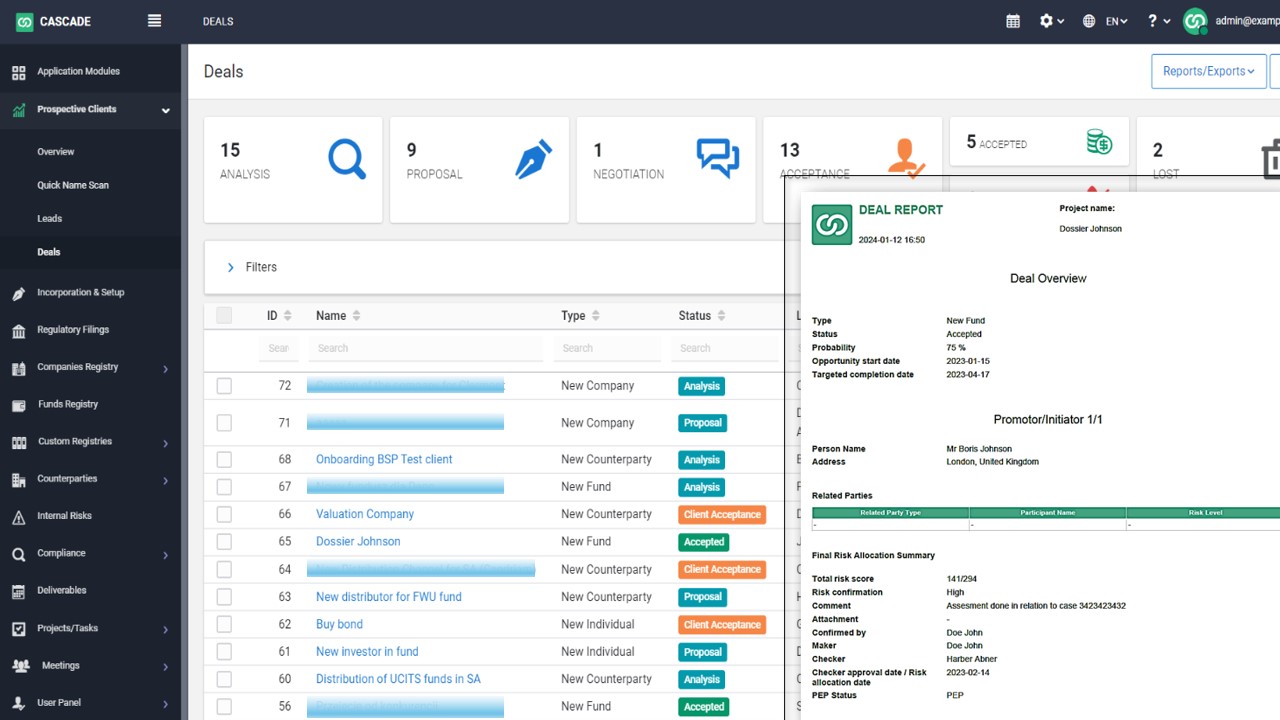
Manual, spreadsheet-based controls testing creates audit trail fragmentation and testing gaps. A centralized compliance platform automates testing schedules (calendar reminders trigger cycles on time), standardizes checklists, and captures results in a single system with automatic timestamping.
When testing identifies control failures, remediation tracking is systematic: corrective actions are documented with target completion dates, follow-up testing is scheduled automatically, and verification is escalated if overdue.
Operationally, this means:
- Testing schedules are calendar-driven, eliminating ad hoc delays and gaps.
- Testing results are centralized, timestamped, and linked to control execution data for complete audit trails.
- Testing scope is consistent: standardized checklists ensure uniform quality across the fund.
- Remediation tracking is systematic with automatic escalations for overdue corrective actions.
- Audit-ready reporting on demand shows testing execution, remediation, and control effectiveness trends.
For Luxembourg fund managers subject to CSSF supervisory visits, embedded workflows ensure control effectiveness is verified on schedule and documented evidence is ready for inspection.
Frequently asked questions
How frequently should AML controls be tested in Luxembourg?
The CSSF does not prescribe a single testing frequency for all controls; instead, your schedule should be proportionate to control criticality and risk. Critical controls that would significantly impact risk if they fail should be tested monthly or quarterly, while lower-risk controls may be tested semi-annually or annually. At minimum, all material AML controls must be tested at least annually, with more frequent testing applied to any control area where failures have been identified.
What documentation is required to demonstrate controls testing to the CSSF?
The CSSF expects documented evidence of your testing schedule, procedures, and results, including which controls were tested, when, by whom, and what was sampled. You must retain findings showing any deviations from control procedures, root cause assessments for identified failures, documented remediation decisions with target completion dates, and follow-up testing results that verify corrective actions were effective.
Who should conduct AML controls testing?
The personnel performing controls testing must be independent of those executing the controls being tested to ensure objective assessment. This typically means internal audit, a dedicated compliance testing function, or an external auditor should conduct the testing, preventing bias from those responsible for control execution.
What should happen if controls testing identifies significant control failures?
Your compliance team must immediately investigate the failure and assess its root cause, then escalate findings to the MLRO and senior management. You must document a formal remediation plan specifying the corrective actions, target completion dates, and responsible parties, followed by re-testing to verify that corrective action was effective and the control is now functioning as designed.
What is Cascade, and how does it simplify AML/KYC compliance?
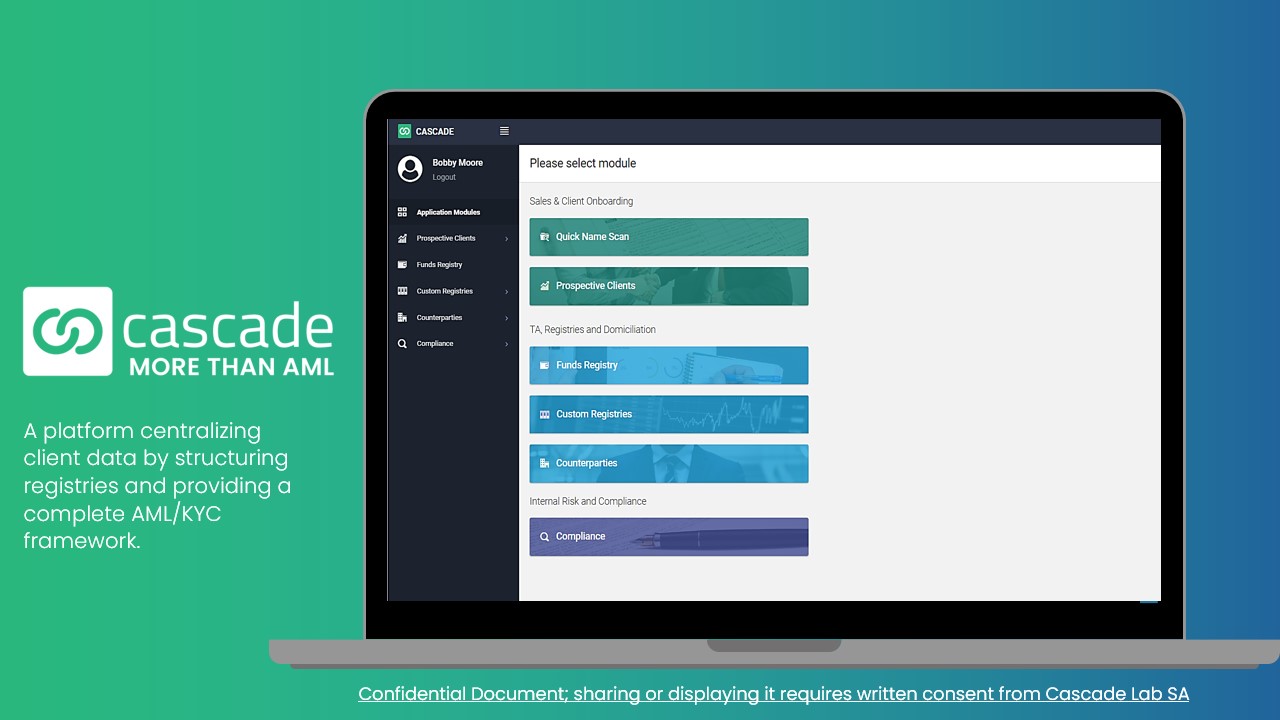
Cascade is an end-to-end AML software (SaaS platform) that centralises client data and supports AML/KYC workflows from onboarding and risk assessment through to ongoing monitoring and reporting. It helps compliance teams standardise processes, manage documents and screening, apply risk-based workflows, and maintain an audit trail of actions and decisions.
Who can benefit from using Cascade?
Cascade supports organisations with AML/KYC obligations, including financial services firms, fintechs, wealth managers, law firms, and corporate service providers.
How does Cascade ensure data security and regulatory compliance?
Cascade provides controlled workflows, activity logging, and audit trails to support traceable AML/KYC processes. Compliance still depends on your policies, configuration, and applicable regulations.
How can I get started with Cascade?
Book a demo with Cascade to discuss your AML/KYC requirements, explore the platform, and identify how it can support your workflows.
Explore Cascade’s AML capabilities
Luxembourg fund managers managing controls testing through manual spreadsheets face audit trail fragmentation and inconsistent control verification. The CSSF expects periodic, documented testing that verifies controls are operating effectively. When testing is performed sporadically and results are scattered across email and local files, compliance teams cannot readily demonstrate to regulators that control failures have been systematically identified and remediated.
Cascade is purpose-built to systematize AML controls testing by automating testing schedules, capturing results in a centralized compliance platform, tracking remediation decisions, and creating audit-ready testing documentation.
To see how Cascade can operationalize your AML controls testing framework and streamline compliance verification, explore our AML capabilities.
Disclaimer: This article is for general information only and based on publicly available sources and regulatory guidance at the time of writing. We have made our best effort to ensure accuracy and relevance to Luxembourg fund management compliance, but AML regulations, CSSF guidance, and business requirements can change. Always verify key details against current CSSF publications and consult with a qualified compliance specialist or legal advisor before making compliance or vendor decisions. Implementation of controls testing procedures and remediation decisions should be tailored to your specific fund structure, risk profile, and regulatory obligations.


 English
 English (Australia)
 English (UK)