AML compliance examiners expect covered financial institutions to produce complete, organized evidence of CDD/KYC compliance decisions, risk assessments, and ongoing monitoring activities. An AML evidence map is the documented framework that traces regulatory obligations back to specific compliance artifacts, ensuring auditable proof that required due diligence was performed and retained according to FinCEN standards.
Without systematic evidence mapping, compliance teams spend weeks gathering documentation across fragmented systems when examiners request proof of BSA/AML program execution. An evidence map bridges this gap by centralizing the relationship between FinCEN CDD Rule requirements and the actual documentation proving compliance.
What is an AML evidence map?
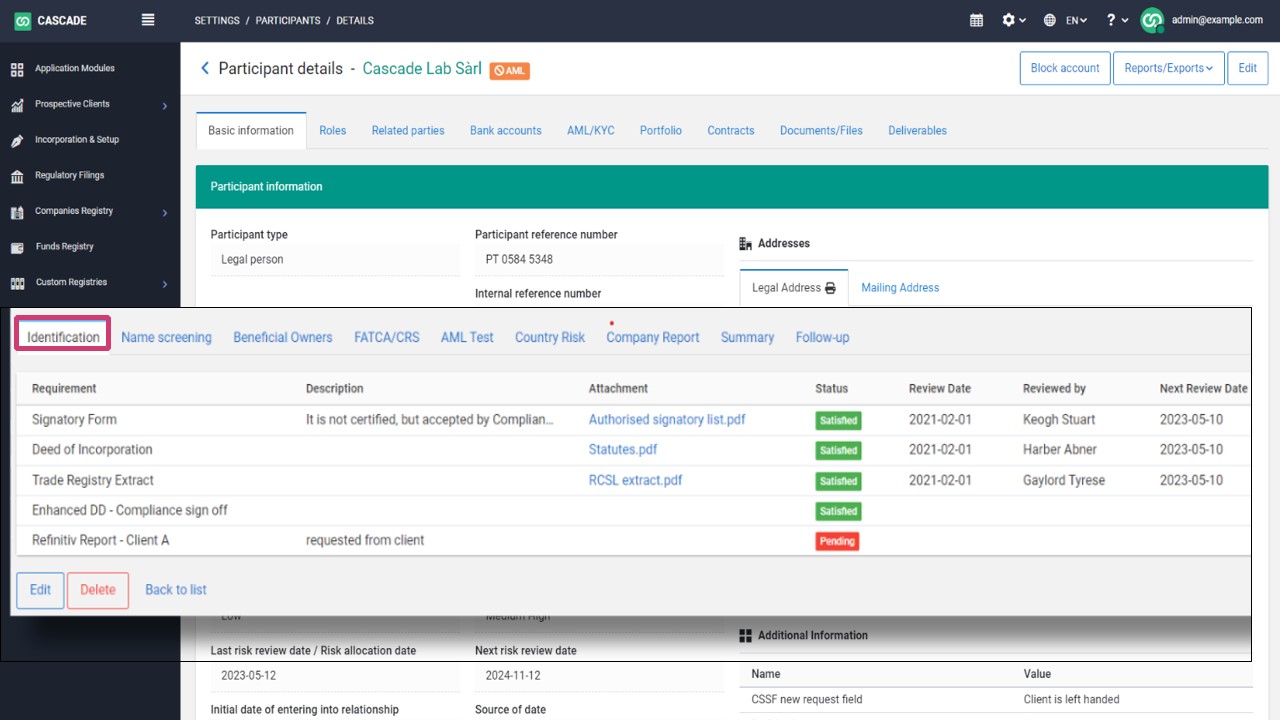
An AML evidence map is an organized reference guide linking specific FinCEN regulatory requirements to the actual client files, screening records, risk assessments, and monitoring documentation that demonstrate compliance. The map does not replace compliance evidence: it indexes it. For each requirement (beneficial owner identification, risk categorization, ongoing monitoring), the map shows which documents in the client file provide proof of completion, when the proof was created, and who validated it.
Financial institutions use evidence maps to answer examiner questions efficiently. When asked “Show me your evidence that this client’s beneficial owners were verified,” compliance teams consult the map, locate the identification copies and verification memo, and produce them immediately. Without a map, the same task requires hours of manual file searching.
Why it matters for US financial institutions
US regulators have raised examination priorities around BSA/AML evidence retention and audit trail completeness. Examiners expect to find documented proof that CDD/KYC procedures were actually performed and recorded systematically.
Three operational pressures drive adoption of evidence maps:
Regulatory demand. FinCEN’s CDD Rule requires covered financial institutions to identify and verify customer identity and beneficial owner identity, understand the nature and purpose of customer relationships to develop risk profiles, and conduct ongoing monitoring. Examiners confirm these activities occurred by reviewing evidence.
Examination efficiency. Manual evidence collection delays exam responses and extends inspection timelines. Evidence maps reduce turnaround time and demonstrate operational control.
Audit defense. Documented evidence maps show examiners that compliance procedures are systematic, not ad hoc. Maps evidence internal control effectiveness and reduce regulatory findings.
FinCEN CDD Rule and BSA evidence standards
The CDD Rule, which amends Bank Secrecy Act regulations, aims to improve financial transparency and prevent criminals and terrorists from misusing companies to disguise their illicit activities and launder their ill-gotten gains.
The CDD Rule codifies four core compliance pillars, plus a fifth requirement for ongoing monitoring:
Customer identification and verification: Obtain and verify customer identity using reliable, independent documentation.
Legal entity beneficial ownership: Identify and verify natural person beneficial owners of business customer accounts.
Risk profiling: Develop a documented customer risk profile based on customer type, jurisdiction, business activity, and beneficial ownership complexity.
Ongoing monitoring: Conduct periodic review of customer transactions and beneficial ownership status to identify unusual patterns and update customer information.
Regulators expect covered institutions to retain evidence for all four pillars in organized client files. Evidence maps index that proof.
Key takeaways
- An evidence map is the operational bridge between regulatory requirements and documented compliance artifacts: it indexes proof of CDD/KYC completion, verification, risk assessment, and ongoing monitoring, enabling rapid exam response and reducing manual file search.
- Systematic evidence mapping demonstrates to examiners that AML/KYC controls are implemented consistently across the client base, not conducted ad hoc: maps show audit trail completeness and support examination readiness.
Building an evidence map: practical framework
Step 1: Inventory FinCEN compliance requirements
Document the specific CDD/KYC obligations applicable to your institution. For broker-dealers, this includes FINRA Rule 3310 requirements. For banks, this includes core BSA compliance.
Standard requirements include: customer identification, beneficial ownership verification, risk assessment, ongoing monitoring, and suspicious activity investigation.
Step 2: Define evidence categories
For each requirement, define which document types prove completion. Beneficial owner verification, for example, requires: identification copy, verification method documentation, beneficial ownership chart, and analyst sign-off memo.
Link each evidence category to the regulatory citation it satisfies.
Step 3: Map client files to evidence requirements
For each client, create an index showing which evidence artifacts exist in the file, the date created, and the verifying officer. Organize the index by requirement (identification, beneficial ownership, risk assessment, ongoing monitoring).
Automated compliance systems can generate these maps from timestamped compliance records. Manual approaches use spreadsheet-based indexes linked to file naming conventions.
Step 4: Track evidence retention and expiration
Document how long each evidence category must be retained (typically 6 years minimum). Flag evidence approaching retention expiration dates. Ensure obsolete evidence is destroyed on schedule while current evidence remains accessible for examination.
AML evidence map matrix: BSA/AML evidence requirements and file documentation
| CDD/KYC Requirement | Evidence Type | Documentation Standard | Retention Period | Verification Owner |
|---|---|---|---|---|
| Customer identification (CIP) | ID copies, passport, driver license | Two forms of government-issued identification; document authenticity verified; linked to customer record | 6 years minimum | Compliance analyst |
| Beneficial ownership verification | Ownership chart, ID copies for UBOs, verification memo | Beneficial owner identification documented; UBO certification received from customer; complex structures verified through independent research | 6 years minimum | Senior compliance officer |
| Customer risk categorization | Risk assessment memo, CDD worksheets, jurisdiction research | Written risk assessment addressing customer type, jurisdiction, transaction patterns, beneficial ownership complexity; risk category assigned (low/medium/high); assessment rationale documented | 6 years minimum | Risk assessment officer |
| Ongoing monitoring documentation | Transaction review summaries, beneficial ownership update confirmations, annual CDD refresh records | Periodic transaction monitoring completed; beneficial ownership updates requested and documented; CDD information refreshed annually minimum; monitoring findings recorded | 6 years minimum | Monitoring analyst |
| Suspicious activity investigation | Alert investigation memo, supporting transaction records, SAR filing confirmation (if applicable) | Alert investigated and documented; findings recorded; determination made whether SAR filing required; if SAR filed, copy retained with filing date | 6 years minimum + SAR retention period | Compliance officer / MLRO |
| Enhanced due diligence (if applicable) | EDD completion memo, additional verification documentation, senior management approval | High-risk determination triggered EDD; specific enhanced procedures completed and documented; senior officer sign-off on EDD completion | 6 years minimum | MLRO |
Common challenges and practical solutions
Challenge 1: Evidence fragmentation. Beneficial ownership documentation sits in email; risk assessments live in spreadsheets; transaction monitoring summaries are maintained separately. No single source shows what evidence exists for each client.
Solution: Centralize evidence storage. Link identification copies, beneficial ownership records, risk assessments, and monitoring documentation to the client record in your compliance system. Generate evidence maps on demand showing all indexed documentation for each client.
Challenge 2: Missing audit trails. Evidence exists but lacks metadata showing who verified it, when verification occurred, or whether verification was documented. Examiners question whether evidence meets audit trail standards.
Solution: Ensure all evidence is timestamped and linked to the verifying officer. Require written documentation (memo or system record) of verification completion. Configure your compliance system to capture timestamps automatically.
Challenge 3: Inconsistent evidence retention. Some files retain documentation for 6 years; others retain longer; some destroy evidence on inconsistent schedules. No centralized tracking of retention compliance.
Solution: Establish a documented retention schedule aligned with regulatory requirements. Implement automated destruction of files on retention expiration dates. Track destruction in a retention log.
Challenge 4: Exam response delays. When examiners request evidence of CDD completion for specific clients, compliance teams manually search files. Compiling evidence takes days.
Solution: Use evidence maps to pre-organize documentation. Link map to electronic file repository so examiners (or internal audit) can rapidly retrieve proof.
Best practices for AML evidence management
Document map structure clearly. Define which evidence categories apply to each client profile (retail vs. institutional, domestic vs. international, high-risk vs. low-risk). Ensure all team members understand the map.
Automate evidence indexing. Use your compliance platform to capture screening results, beneficial ownership certifications, risk assessments, and monitoring activities with automatic timestamps. Let the system generate evidence maps from structured records.
Verify evidence completeness monthly. Run a data quality check confirming that each client has completed evidence for all required categories. Flag gaps for immediate remediation.
Retain evidence systematically. Implement automated file destruction on retention expiration dates. Track all destructions in a centralized log.
Train staff on evidence standards. Conduct quarterly training on which evidence types are required, documentation standards, and retention periods.
Test evidence during internal audit. Sample client files and confirm evidence maps are accurate and complete. Document audit findings.
Frequently asked questions
What is Cascade and how does it simplify AML/KYC compliance?
Cascade is an end-to-end AML Software (SaaS Platform) that centralises client data and supports AML/KYC workflows from onboarding and risk assessment through to ongoing monitoring and reporting. It helps compliance teams standardise processes, manage documents and screening, apply risk-based workflows, and maintain an audit trail of actions and decisions.
Who can benefit from using Cascade?
Cascade supports organisations with AML/KYC obligations, including financial services firms, fintechs, wealth managers, law firms and corporate service providers.
How does Cascade ensure data security and regulatory compliance?
Cascade provides controlled workflows, activity logging and audit trails to support traceable AML/KYC processes. Compliance still depends on your policies, configuration and applicable regulations.
How can I get started with Cascade?
Book a demo with Cascade to discuss your AML/KYC requirements, explore the platform and identify how it can support your workflows.
Why is evidence mapping critical for exam readiness?
Examiners request proof that CDD/KYC procedures were performed and documented. An evidence map shows examiners instantly where that proof exists: what documents, when created, who verified them. Maps demonstrate that compliance is systematic, not ad hoc.
Does evidence mapping reduce the compliance burden?
Yes. Manual evidence gathering during exams delays response and extends inspection timelines. Evidence maps pre-organize documentation so compliance teams produce proof in hours, not days. Maps also surface gaps before examiners do.
What is the difference between evidence retention and evidence mapping?
Evidence retention is storing compliance documentation for 6 years. Evidence mapping is indexing where that evidence is stored and which compliance requirement it satisfies. Both are required: retention ensures documentation exists; mapping makes documentation findable.
Explore Cascade’s AML capabilities
US financial institutions managing evidence across email, spreadsheets, and fragmented file systems face examination delays and audit exposure. When FinCEN examiners request evidence of beneficial owner verification or ongoing monitoring, compliance teams should produce proof within hours, not days.
Cascade is purpose-built to centralize AML evidence by capturing CDD/KYC completion, beneficial ownership verification, risk assessments, and monitoring activities in timestamped, organized client records. By linking compliance evidence to regulatory requirements and generating evidence maps on demand, Cascade enables your compliance team to respond to examinations rapidly while demonstrating systematic, auditable control execution. To see how Cascade can streamline your evidence management and examination readiness, explore Cascade’s AML capabilities.
Disclaimer
This article is for general information only and based on publicly available sources and regulatory guidance at the time of writing. We have made our best effort to ensure accuracy and relevance to US financial services AML compliance, but FinCEN regulations, guidance, and business requirements can change. Cascade does not provide legal or compliance advice: use of the Cascade platform does not guarantee regulatory compliance or examination success. Always verify key details against current FinCEN publications and consult with a qualified compliance specialist or legal advisor before making compliance or vendor decisions.


 English
 English (Australia)
 English (UK)