How to build a compliant client registry for Dutch corporate service providers
Dutch corporate service providers operate under one of Europe’s most demanding regulatory regimes. The Dutch Financial Intelligence Unit (FIU/FIOD) and the Netherlands Authority for the Financial Markets (AFM) enforce explicit requirements that corporate service providers maintain centralized, auditable client registries that document customer due diligence, beneficial ownership verification, and ongoing monitoring evidence across all client relationships.
Yet compliance teams managing multiple clients, complex corporate structures, and cross-border beneficial ownership verification spread client data across email, document repositories, and disconnected spreadsheets. When the AFM or FIOD requests evidence of client registry completeness, compliance officers must manually search multiple systems to assemble records, creating audit exposure and demonstrating organizational dysfunction.
A purpose-built client registry is not a nice-to-have. It is the foundational control that enables corporate service providers to operationalize risk-based due diligence, demonstrate regulatory compliance, and prevent regulatory findings during examination.
The client registry imperative for Dutch corporate service providers
Dutch corporate service providers (Company Formation Service providers, Administratiegebouwen, and Trust Office operators) face explicit regulatory expectations. The Ministry of Justice’s Sanctions and Anti-Money Laundering Supervision framework and the AFM’s Corporate Service Provider Supervision guidelines establish that client registries must be complete, current, and auditable.
The regulatory expectation is clear: when a regulator examines your compliance, it will request a list of all clients, their beneficial ownership status, their risk assessment, and the due diligence evidence supporting each assessment. If your client data is fragmented across systems, if beneficial ownership information is out-of-date, or if due diligence documentation is incomplete, regulators will document control deficiencies.
A centralized client registry solves this operational challenge by creating a single source of truth where client data, due diligence documentation, beneficial ownership records, and compliance status are linked, current, and auditable. Regulatory requests can be answered with confidence because client data is complete and compliance evidence is systematically maintained.
What is a client registry?
A client registry is a centralized database that maintains current information about all client relationships, including client identity, beneficial ownership structure, risk assessment, due diligence documentation, and monitoring status. The registry serves as the institutional memory of client relationships and the primary evidence of regulatory compliance.
For corporate service providers, the client registry must include:
- Client identity and contact information
- Corporate registration number and jurisdiction of incorporation
- Ultimate beneficial ownership identification and verification status
- Risk assessment categorization (low/medium/high)
- Due diligence documentation (corporate filings, beneficial ownership evidence, third-party verification records)
- Screening results (sanctions, adverse media, PEP screening)
- Ongoing monitoring status (last review date, next scheduled review)
- Regulatory notes (compliance findings, regulatory inquiries, notable events)
- Service agreements and fee structures (as required by AFM oversight)
The registry must be accessible to all compliance staff, current (updated within 30 days of material changes), and auditable (all changes logged with timestamp and responsible officer).
Why client registry completeness matters for Dutch CSPs
Dutch corporate service providers face three regulatory pressures that a complete client registry addresses:
Beneficial ownership transparency requirements. The Dutch government has implemented strict beneficial ownership transparency requirements. Corporate service providers must identify and verify beneficial ownership for all client entities and maintain current records. AFM examinations specifically focus on beneficial ownership verification completeness. A client registry that tracks beneficial ownership status, verification date, and supporting evidence demonstrates compliance.
Risk-based due diligence. The AFM expects corporate service providers to apply risk-based due diligence proportionate to assessed client risk. A complete client registry enables risk-based workflows: low-risk clients receive streamlined monitoring; high-risk clients trigger enhanced due diligence. If your client data is fragmented, you cannot operationalize risk-based procedures.
Regulatory examination readiness. When the AFM or FIOD requests client registry evidence, you must produce complete, current data on demand. If client information is fragmented across systems, examination responses take weeks and often contain errors. A centralized registry enables you to respond to regulatory requests within hours with confidence that all clients are included and all information is current.
Regulatory framework: AFM and Dutch CSP requirements
Dutch corporate service provider regulation establishes explicit client registry expectations:
The AFM’s Supervision of Corporate Service Providers framework requires that corporate service providers maintain complete records of all clients and due diligence evidence. The framework explicitly addresses beneficial ownership verification as a core control.
The Dutch Sanctions Act requires that corporate service providers screen clients against sanctions lists and maintain screening evidence.
The Anti-Money Laundering Directive implementation requires beneficial ownership identification and verification for all legal entity clients. Corporate service providers must maintain documented evidence that beneficial ownership has been verified.
Your client registry is the primary evidence that you comply with these requirements.
Building your client registry: four-step implementation framework
Step 1: Define client data elements and verification standards
Establish the data elements that must be captured for every client:
- Basic client information: Legal name, registered address, jurisdiction of incorporation, registration number, service start date
- Client type classification: Individual investor, corporate entity, trust, foundation, partnership, or other structure
- Beneficial ownership structure: Identify all beneficial owners with >25% ownership (Dutch transparency threshold); verify ownership documentation
- Risk assessment: Assign low/medium/high risk based on jurisdiction, client type, business purpose, beneficial ownership opacity
- Due diligence evidence: Link client record to supporting documentation (corporate filings, beneficial ownership declarations, third-party verification)
- Screening status: Document screening against sanctions lists, adverse media, PEP screening; record screening date and results
- Monitoring status: Record last beneficial ownership review date, next scheduled review, and monitoring findings
Define verification standards for each data element. For example, beneficial ownership verification might require: corporate filings for Dutch BV/NV entities, beneficial ownership declarations signed by authorized officers, third-party verification services for complex structures, or documentary evidence of ownership for foreign entities.
Step 2: Implement centralized data collection and linking
Create a unified client profile structure where all client data is linked in one location:
- Client identity linked to supporting documentation (copies of registration certificates, business licenses)
- Beneficial ownership structure linked to verification evidence (corporate filings, ownership declarations, third-party verification records)
- Risk assessment linked to assessment rationale (documented explanation of risk categorization)
- Screening results linked to client record (searchable by date, source, and result)
- Monitoring history linked to client record (previous reviews, findings, updates)
- Service agreement and fee information linked to client record (as required by AFM oversight)
Ensure the registry is centralized so that all compliance staff reference the same, current data. Avoid decentralized spreadsheets where versions proliferate.
Step 3: Establish beneficial ownership verification and re-verification workflows
Configure systematic beneficial ownership verification:
- Initial verification: For all new clients, beneficial ownership must be verified at onboarding using documentary evidence appropriate to client type (corporate filings for Dutch entities, third-party services for foreign entities, beneficiary declarations for trusts)
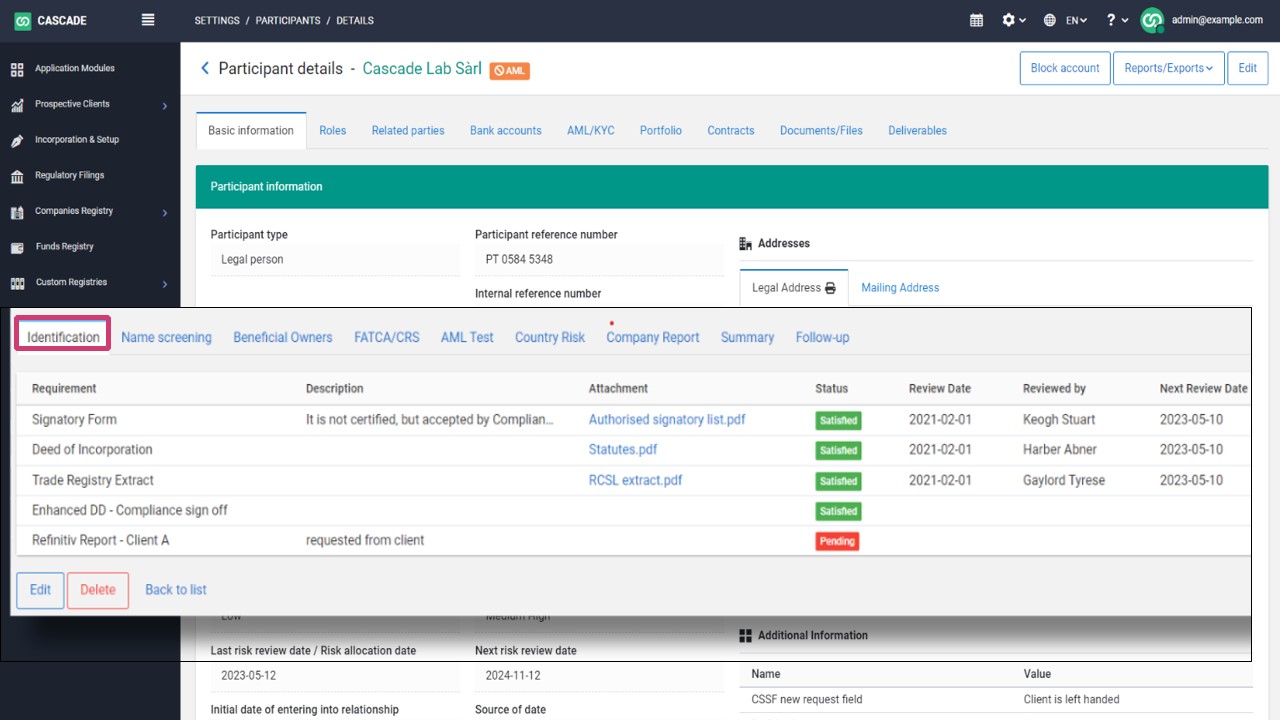
- Verification documentation: Retain all beneficial ownership evidence in the client file (copies of documents, third-party verification reports, dated declarations)
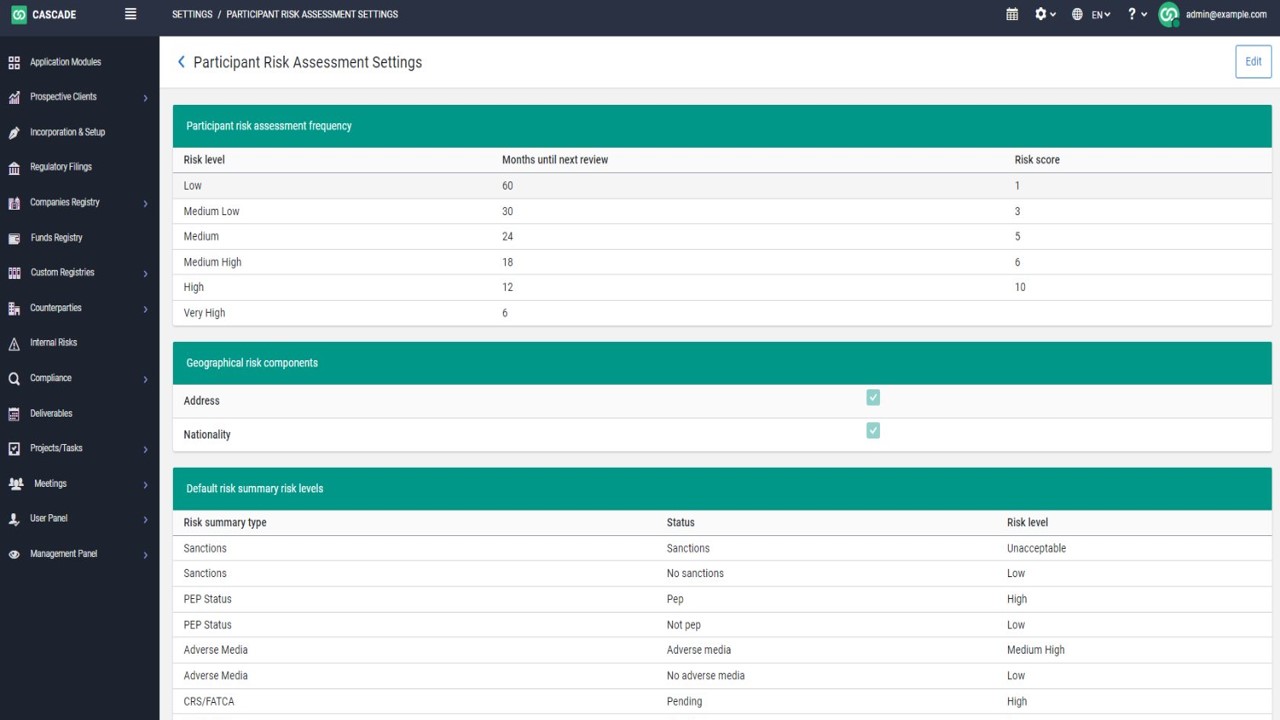
- Re-verification schedule: Dutch corporate clients re-verified annually; foreign entities re-verified annually; high-risk clients re-verified quarterly
- Verification triggers: Material changes to beneficial ownership structure require immediate re-verification (documented in change request)
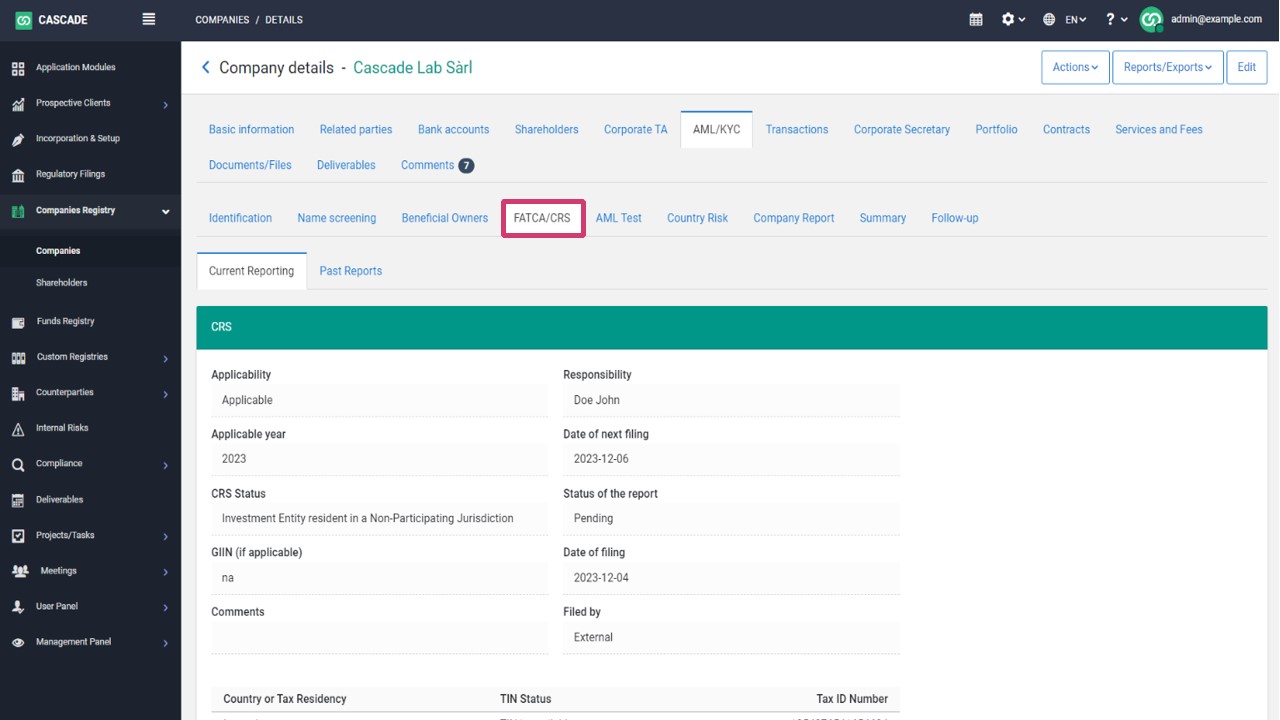
- Verification completion tracking: Client registry shows verification status with date, evidence, and responsible officer
Step 4: Operationalize client registry through automated monitoring
Implement automated processes to maintain registry completeness:
- Data entry standards: Define mandatory fields that must be completed before client activation
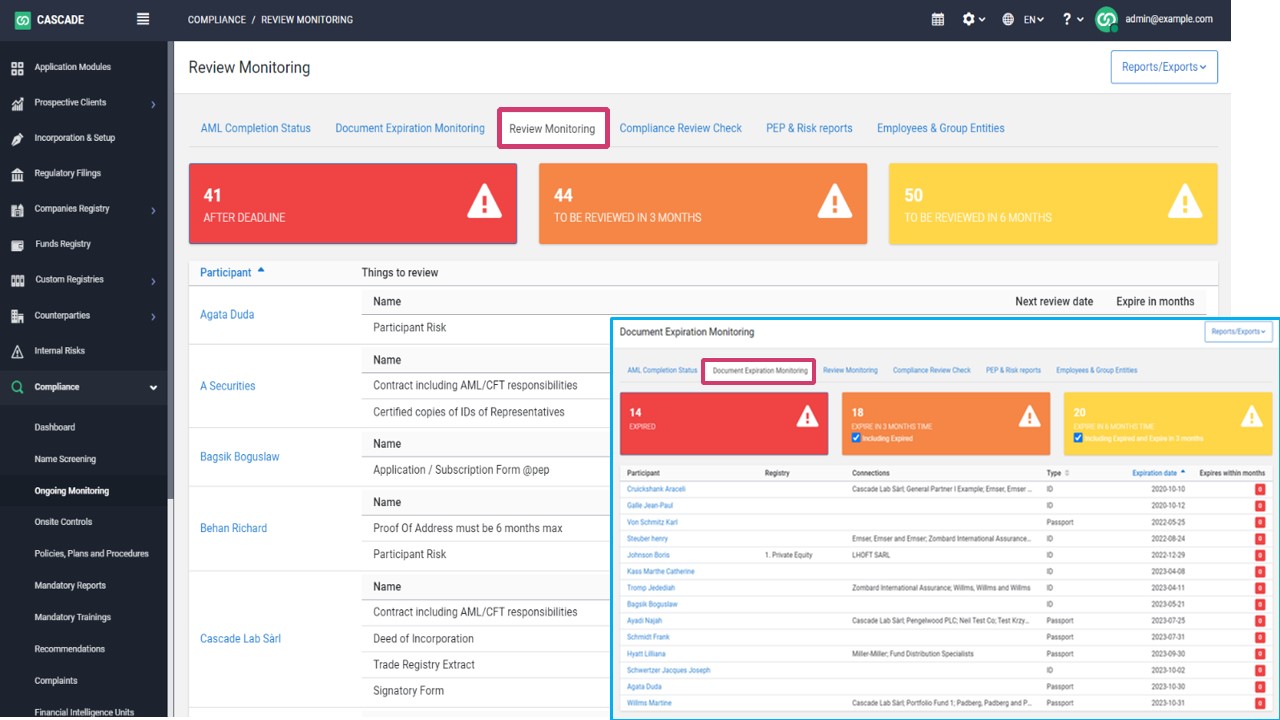
- Verification tracking: Automated reminders when beneficial ownership re-verification is due
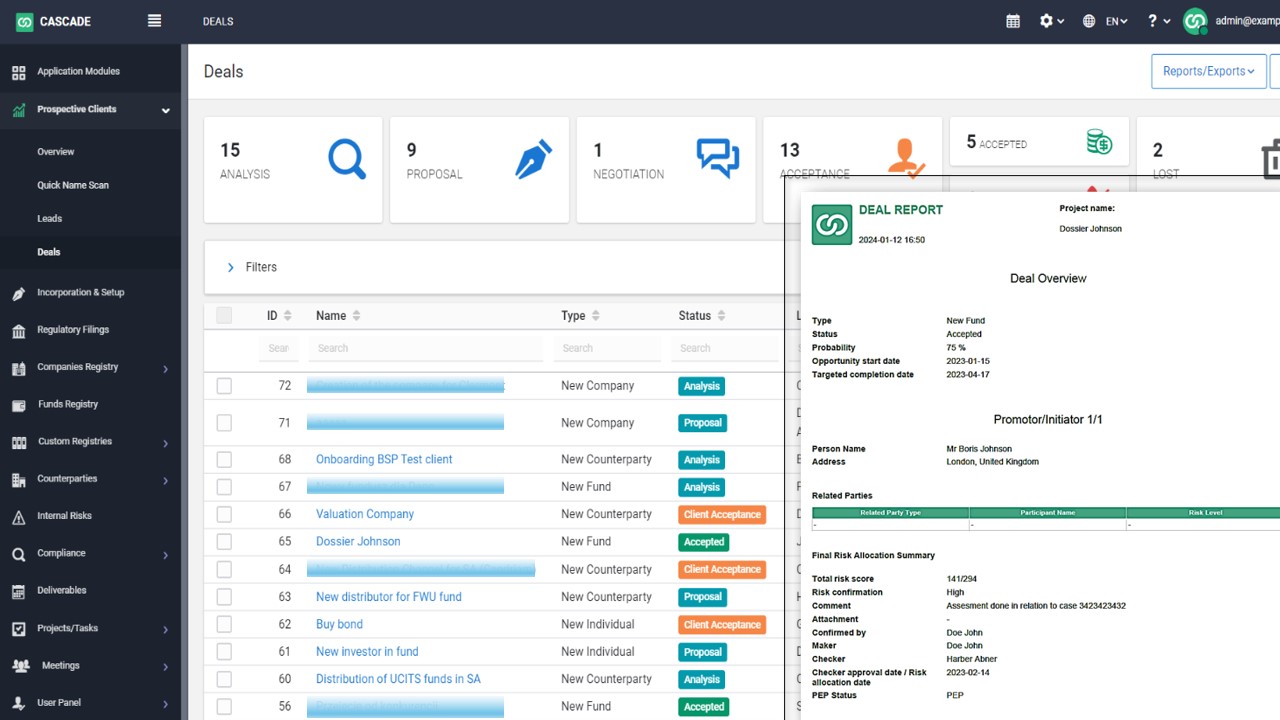
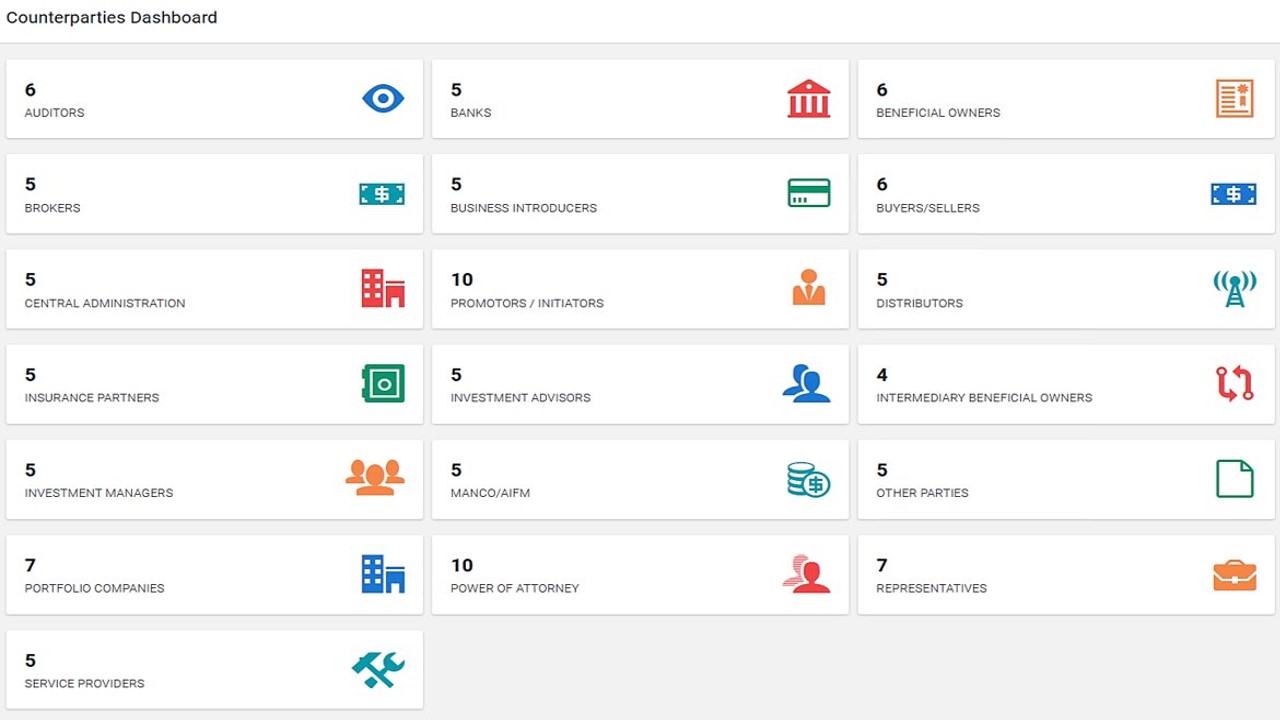
- Monitoring status dashboards: Visibility of client registry completeness metrics (% clients with current beneficial ownership verification, % clients screened, % clients with documented risk assessment)
- Regulatory export capabilities: Ability to generate client registry reports on demand for AFM/FIOD requests
- Audit trail logging: All registry changes logged with timestamp, modification type, and responsible officer
Client registry architecture: spreadsheet vs. centralized platform
| Client registry component | Spreadsheet-based approach | Cascade centralized registry |
|---|---|---|
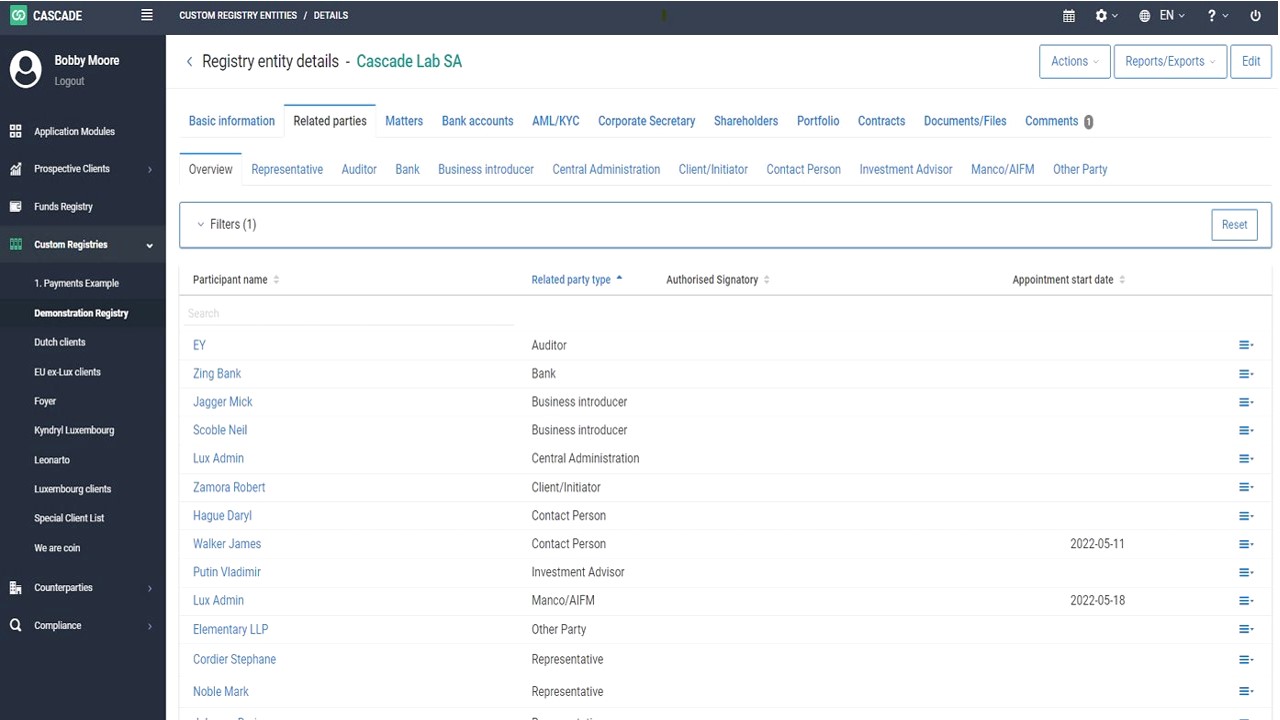
| Client data centralization | Client information scattered across multiple spreadsheets (client master, beneficial ownership tracker, risk assessment spreadsheet, screening spreadsheet). Different staff reference different versions; data inconsistency common. No single source of truth. | All client data linked in unified client profile. Client identity, beneficial ownership, risk assessment, screening results, and monitoring status accessible from one location. Single source of truth accessible to all compliance staff. |
| Beneficial ownership verification tracking | Beneficial ownership verification documented in spreadsheet with last verification date; re-verification schedules managed through calendar reminders or to-do lists. Verification deadlines missed; re-verification triggered manually. Beneficial ownership documentation stored separately in file shares. | Beneficial ownership verification linked to client record with verification date, evidence, and verification method. Re-verification automatically triggered on configured schedule (annually for Dutch entities, quarterly for high-risk). Verification deadline tracking shows overdue verifications. Supporting documentation linked to verification record. |
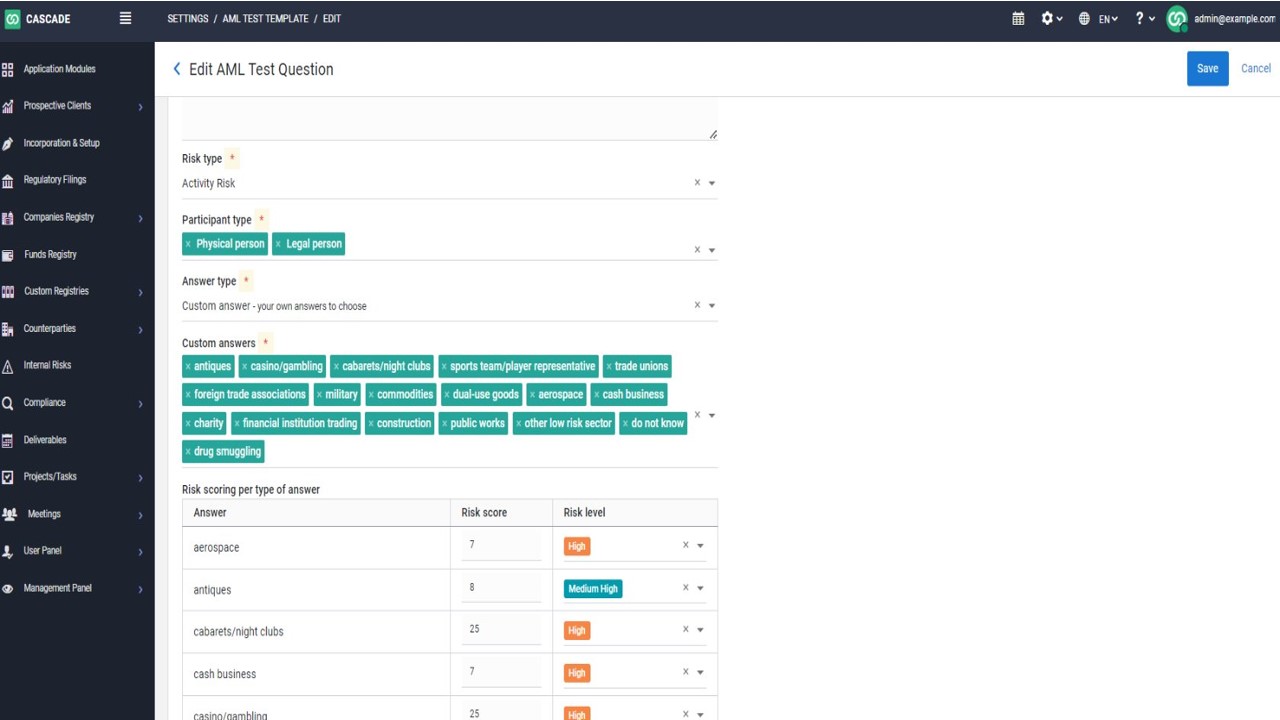
| Risk assessment and categorization | Risk assessment assigned manually in spreadsheet; different analysts assign different risk categories for similar clients; risk rationale not documented; risk re-assessment triggered manually based on ad hoc judgments. | Risk assessment criteria configured once; scoring applied consistently to all clients. Risk rationale documented automatically. Risk re-assessment triggered automatically when beneficial ownership changes, regulatory status changes, or scheduled review occurs. Risk status visible in client profile. |
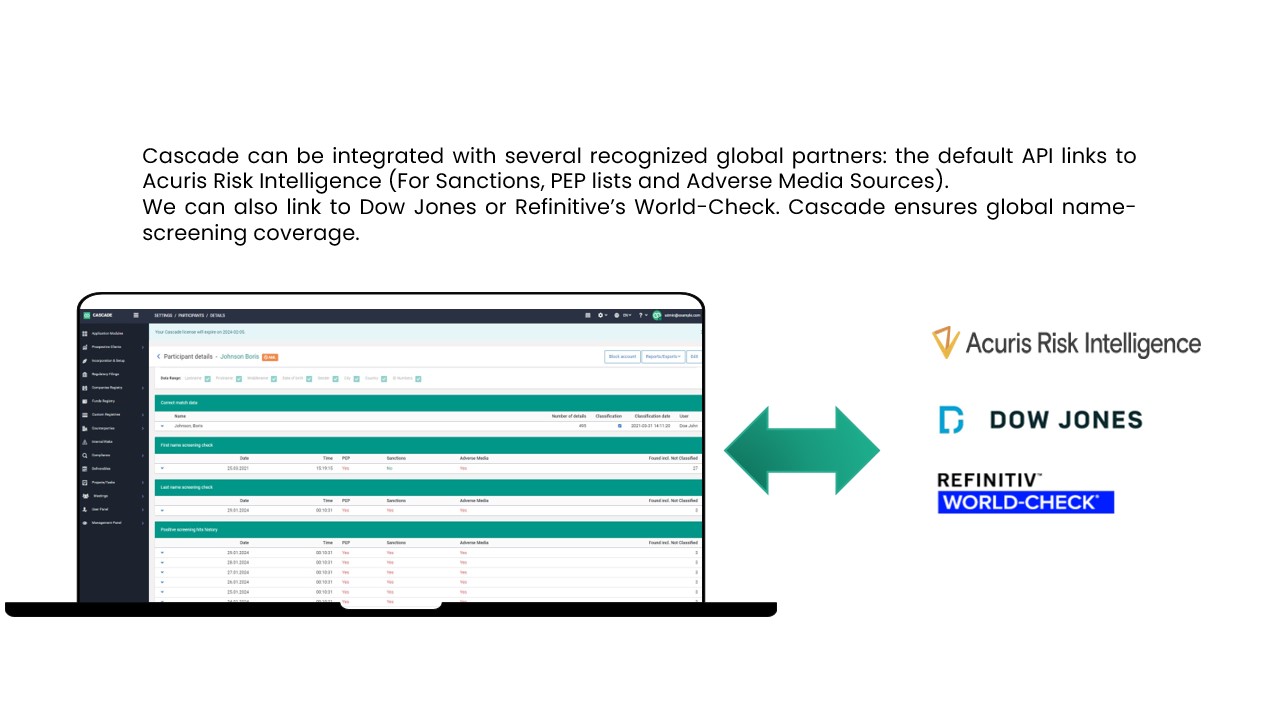
| Screening and monitoring execution | Screening conducted through vendor portals; results exported to spreadsheet; screening completion date unclear; re-screening cadence drifts; some clients not rescreened for months. Monitoring status invisible. | Screening integrated with client profile; screening triggered automatically on risk-based schedule (quarterly for medium-risk, monthly for high-risk). Screening results imported automatically and linked to client record. Rescreening reminders sent automatically. Screening audit trail shows all historical results. |
| Regulatory response capability | AFM/FIOD request for client registry requires manual data assembly from multiple spreadsheets; takes weeks; errors common; missing clients possible. Regulators question completeness of response. | Client registry report generated on demand showing all clients, risk assessment, beneficial ownership verification status, and screening status. Report produced within hours with confidence that all clients are included and all data current. Regulatory response demonstrates systematic, complete compliance. |
Operationalizing your client registry through centralization
Manual, spreadsheet-based client registries create inevitable compliance gaps. Beneficial ownership verification dates slip past re-verification deadlines because tracking is manual; risk assessments are inconsistent because standards are informal; client data is incomplete because information is fragmented across systems. When the AFM requests your client registry, you discover that your data is stale and incomplete.
A centralized client registry platform eliminates these operational gaps by creating a single source of truth where client data is linked, verified, and current. Beneficial ownership verification is tracked systematically with automated re-verification reminders; risk assessment applies consistent criteria to all clients; screening results are imported automatically and re-screening is triggered on schedule. When you receive a regulatory request, you generate a complete, current client registry report in hours rather than assembling fragmented spreadsheets over weeks.
The compliance benefit is substantial. Your AFM examination demonstrates that client registry data is complete, current, and consistently maintained. Beneficial ownership verification rates are high. Risk assessments are documented and consistently applied. Regulatory requests are answered confidently with complete, auditable evidence.
For Dutch corporate service providers managing multiple client relationships and complex ownership structures, this shift from manual spreadsheet administration to centralized registry management provides the operational control that regulators expect and the compliance evidence that withstands examination.
Common implementation challenges and solutions
Challenge 1: Fragmented beneficial ownership records
Beneficial ownership documents are scattered across file shares; verification dates are unclear; re-verification deadlines are missed. Different staff members cannot easily determine whether beneficial ownership is current.
Solution: Centralize beneficial ownership records by linking all supporting documentation to the client profile. Implement automated re-verification scheduling based on client risk category. Create a dashboard showing beneficial ownership verification status across all clients. Escalate overdue verifications to supervisory staff.
Challenge 2: Inconsistent risk categorization
Different compliance officers assign different risk categories to similar clients. Risk rationale is not documented. Risk categories drift over time without systematic review.
Solution: Establish documented risk assessment criteria with specific examples. Implement a risk assessment workflow that requires documented rationale for each client risk assignment. Conduct supervisory review of risk categorization for all high-risk and medium-risk clients. Re-assess risk annually or when material changes occur.
Challenge 3: Client data incompleteness
New clients are onboarded before complete due diligence is conducted. Client registry shows incomplete data (missing beneficial ownership, missing screening results). You cannot confidently state that all clients are properly documented.
Solution: Implement a client activation workflow that requires all mandatory data elements before client status becomes “active.” Conduct monthly completeness audits identifying clients with missing beneficial ownership verification, missing screening results, or missing risk assessment. Remediate gaps systematically.
Challenge 4: Screening execution gaps
Initial screening is conducted inconsistently. Ongoing screening deadlines are missed. Screening results are exported to vendor portals and disconnected from client records. You cannot easily demonstrate that all clients have been screened.
Solution: Integrate screening with your client registry so that screening is triggered automatically at onboarding and on a risk-based re-screening schedule. Link screening results directly to client records. Create a screening status dashboard showing screening completion rates and overdue screenings. Test screening execution monthly.
Challenge 5: Inadequate response to regulatory requests
When the AFM requests your client registry, you must manually assemble data from multiple systems. Responses are delayed, incomplete, and error-prone. Regulators question data quality.
Solution: Implement a client registry report that can be generated on demand showing all required data elements (client identity, beneficial ownership verification status, risk assessment, screening results). Ensure the report is comprehensive and can be produced within hours of request. Test the report functionality monthly.
Best practices for client registry implementation
Establish data governance. Assign clear responsibility for client registry completeness. The Compliance Officer owns framework design; operations staff input data; supervisory staff validate completeness monthly. Document governance in writing.
Define mandatory data elements. Specify which data elements must be completed before client activation. Avoid optional fields that drift incomplete. If data is not mandatory, it often remains blank.
Implement verification standards. Define what constitutes adequate beneficial ownership verification for different client types (Dutch entities, foreign entities, complex structures, trusts). Standards must be specific enough that different staff reach the same conclusions.
Automate verification tracking. Use a system that automatically tracks beneficial ownership re-verification dates and generates reminders. Manual calendar management creates missed deadlines.
Test registry completeness monthly. Audit the registry monthly to identify missing beneficial ownership, missing screening results, or missing risk assessments. Report findings to the Compliance Officer.
Conduct annual registry updates. At minimum annually, review all client records for material changes. Update beneficial ownership, risk assessment, and screening as needed. Document all updates.
Prepare for regulatory requests. Test your ability to generate a comprehensive client registry report monthly. Ensure you can produce the report within hours of request.
Frequently asked questions
What beneficial ownership verification standard should I use for Dutch corporate entities?
For Dutch BV and NV entities, official registration with the Dutch Chamber of Commerce (KVK) is the primary source of beneficial ownership information. Verify current ownership through the KVK database. For entities with nominees or complex beneficial ownership, request a certified beneficial ownership declaration signed by authorized officers. Re-verify annually or immediately upon notification of ownership changes.
How should I handle beneficial ownership when a client entity uses a holding company or trust structure?
Trace beneficial ownership through the structure to identify ultimate beneficial owners (individuals with >25% control, or the entire beneficial ownership chain if >25% is held by another entity). For holding companies, request corporate filings showing ownership. For trusts, request trust documents identifying beneficiaries. For complex multi-layer structures, you may need to request third-party beneficial ownership verification services.
How frequently should I re-verify beneficial ownership for high-risk clients?
Dutch corporate service provider best practice is to re-verify beneficial ownership for high-risk clients quarterly (every 3 months). Document the re-verification in the client record showing date, verification method, and any changes identified. If ownership changes are identified, update the client risk assessment if the change affects risk categorization.
What should I do if a client refuses to provide beneficial ownership documentation?
Beneficial ownership verification is mandatory. If a client refuses to provide adequate documentation, you have limited options: (1) Request beneficial ownership documentation again with a deadline for response; (2) Engage a third-party beneficial ownership verification service; (3) Refuse to activate or continue the client relationship. Document your attempts to verify beneficial ownership and the reason why verification was not obtained.
What is Cascade and how does it simplify AML/KYC compliance?
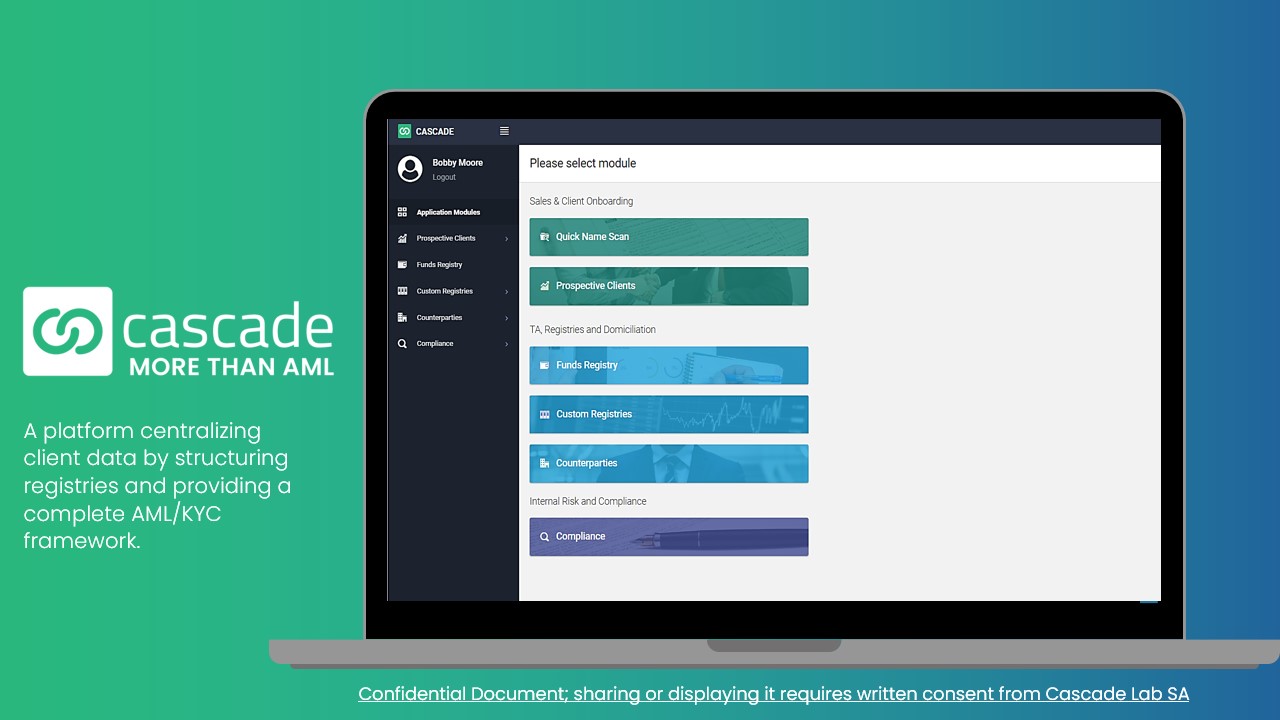
Cascade is an end-to-end AML Software (SaaS Platform) that centralises client data and supports AML/KYC workflows from onboarding and risk assessment through to ongoing monitoring and reporting. It helps compliance teams standardise processes, manage documents and screening, apply risk-based workflows, and maintain an audit trail of actions and decisions.
Who can benefit from using Cascade?
Cascade supports organisations with AML/KYC obligations, including financial services firms, fintechs, wealth managers, law firms and corporate service providers.
How does Cascade ensure data security and regulatory compliance?
Cascade provides controlled workflows, activity logging and audit trails to support traceable AML/KYC processes. Compliance still depends on your policies, configuration and applicable regulations.
How can I get started with Cascade?
Book a demo with Cascade to discuss your AML/KYC requirements, explore the platform and identify how it can support your workflows.
Explore Cascade’s client registry capabilities
Dutch corporate service providers managing client relationships across spreadsheets and disconnected file shares struggle to demonstrate AFM compliance. Your beneficial ownership verification data is out-of-date; risk assessments are inconsistent; regulatory requests require weeks of manual data assembly. The AFM examination becomes a stressful search for fragmented evidence rather than a confident demonstration of systematic compliance.
Cascade purpose-built to centralize your client registry, embed beneficial ownership verification workflows, and maintain a complete, auditable record of all client due diligence and monitoring. Client data is linked in unified profiles; beneficial ownership re-verification is triggered automatically; risk assessment applies consistent criteria to all clients; regulatory requests are answered within hours with comprehensive, current data.
To see how Cascade operationalizes your client registry and enables AFM-ready compliance, explore Cascade’s AML capabilities.
Disclaimer
This article is for general information only and based on publicly available sources and regulatory guidance at the time of writing. We have made our best effort to ensure accuracy and relevance to Dutch corporate service provider compliance, but AFM regulations, guidance, and business requirements can change. Always verify key details against current AFM publications and consult with a qualified compliance specialist or legal advisor before making compliance or vendor decisions.


 English
 English (Australia)
 English (UK)